
I am currently completing my Ph.D. at Johns Hopkins University under the supervision of Prof. Yi Li, where my research explores how topological electronic states and frustrated magnetism can give rise to novel forms of unconventional superconductivity. I am motivated by the conceptual frontiers where existing frameworks used to describe unconventional superconducting pairing order are insufficient. By developing theoretical models that describe the interplay between topological band structure, nontrivial magnetic textures, and unconventional superconducting order, I aim to establish new paradigms that can guide the design and application of quantum materials.
Research Interests
- Unconventional superconductivity
- Topological many body order
- Strongly correlated systems
- Frustrated magnetism
Below you can find a short description of my research as well as publications and preprints. An up-to-date list of publications can be found at Google Scholar, arXiv, or ORCID.
Research Experience
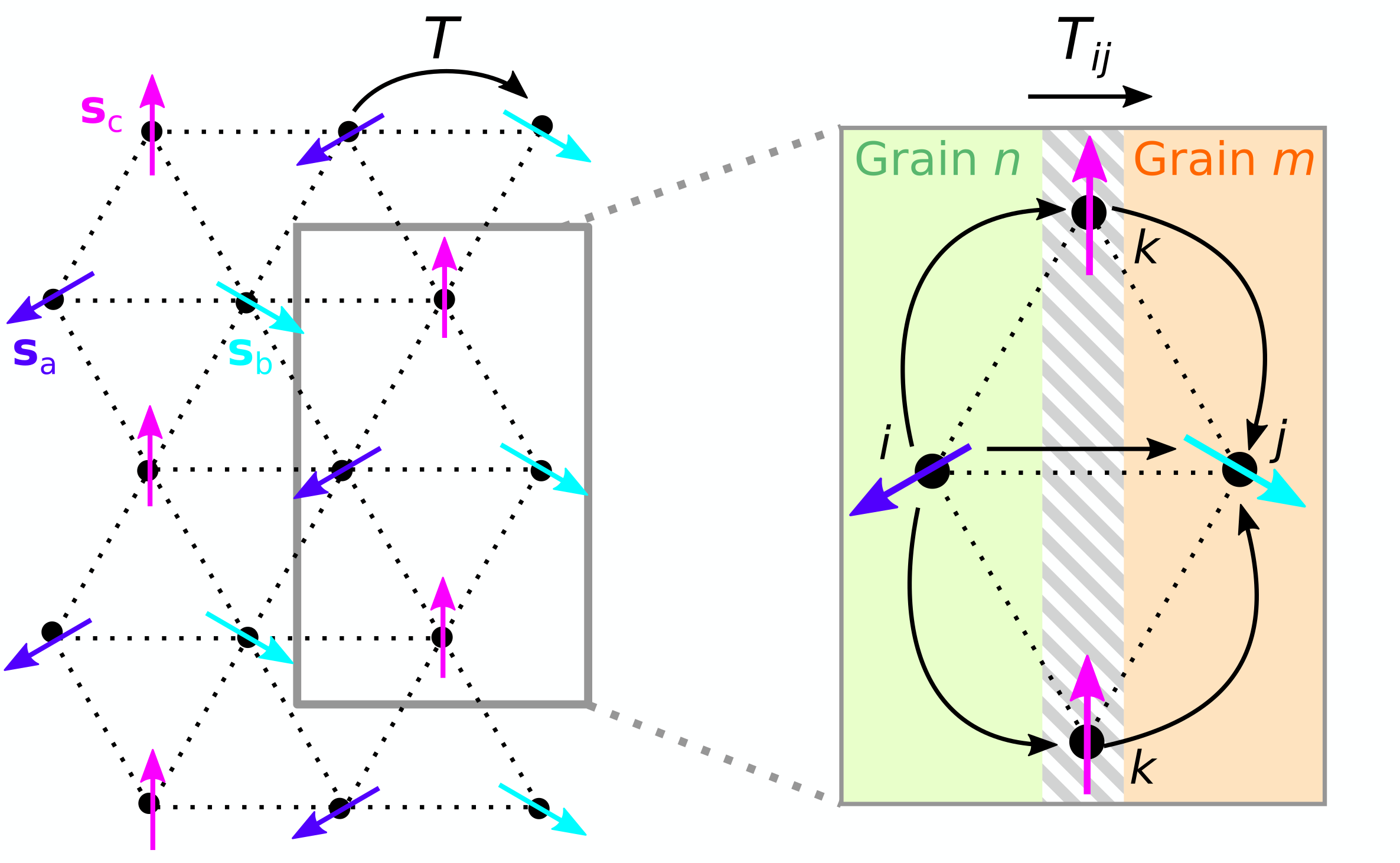
Frustrated Magnetism and Unvoncentional Superconductivity: [Pub. 4 and 5]
- Employed a combination of symmetry analysis and T-matrix formalism to demonstrate that coupling itinerant electrons to a noncollinear classical exchange field can induce anisotropic Josephson couplings between superconducting d-vectors, analogous to Dzyaloshinskii-Moriya’s anisotropic superexchange in magnetism.
- Demonstrated that noncollinear spin textures can generate spin triplet pairing correlations, produce a Josephson diode effect, and can favor a spatially varying superconducting order, which can lead to anomalous vortices for nonunitary pairing order.
Novel States of a Spinor Superconductor: [Pub. 3]
- Studied a class of topological pairing order with Berry phase enforced half-integer partial wave symmetry arising from pairing states from Fermi surfaces with Chern numbers differing by odd integers.
- Analyzed the nontrivial surface states of a lattice model of a spinor superconductor, which violates Nielsen-Ninomiya theorem due to broken U(1) symmetry, and showed that the superfluid velocity obeys a fractionalized Mermin-Ho relation.
Monopole Superconductivity: [Pub. 2]
- Investigated monopole harmonic superconductivity, a class of topological many-body order in which Cooper pairs carry nontrivial geometric phase.
- Utilized symmetry principles, exact diagonalization, and many-body techniques to propose a set of phase-sensitive probes to distinguish monopole superconductors from other unconventional superconductors.
Publications and Preprints
- "Spatially inhomogeneous triplet pairing order and Josephson diode effect induced by frustrated spin textures"
G. R. Frazier and Y. Li
arXiv:2510.25756 (2025), Under review - "Anisotropic Josephson Coupling of d-vectors Arising from Interplay with Frustrated Spin Textures"
G. R. Frazier, J. Zhang, and Y. Li
arXiv.2506.15661 (2025), Under review - "Berry Phase Enforced Spinor Pairing Order"
Y. Li and G. R. Frazier
arXiv:2409.09579 (2024), Under review - "Designing Phase Sensitive Probes of Monopole Superconducting Order"
G. R. Frazier, J. Zhang, J. Zhang, X. Sun, and Y. Li
Phys. Rev. Research 6 043189 (2024) - "Acquisition and Analysis of Scanning Tunneling Spectroscopy Data—WSe2 Monolayer"
R. M. Feenstra, G. R. Frazier, Y. Pan, S. Fölsch, Y.-C. Lin, B. Jariwala, K. Zhang, and J. Robinson
J. Vac. Sci. Technol. A 39, 011001 (2021)
Recordings of Presentations
- “Fractional Mermin-Ho relation in a spinor superconductor” (2025)
13th International Conference on Elastic, Electrical, Transport, and Optical Properties of Inhomogeneous Media
New York City, NY
Link to Recording | Slides